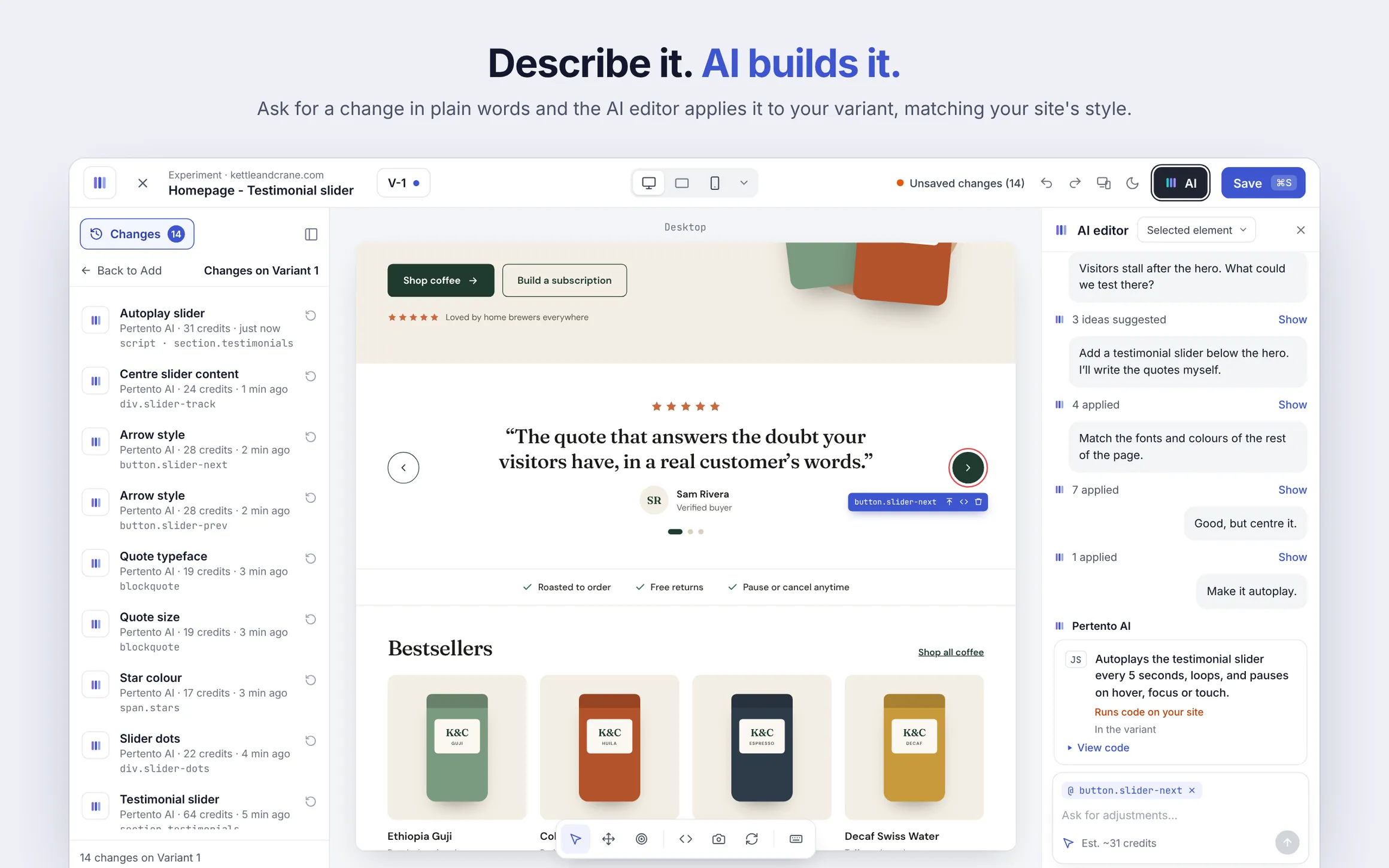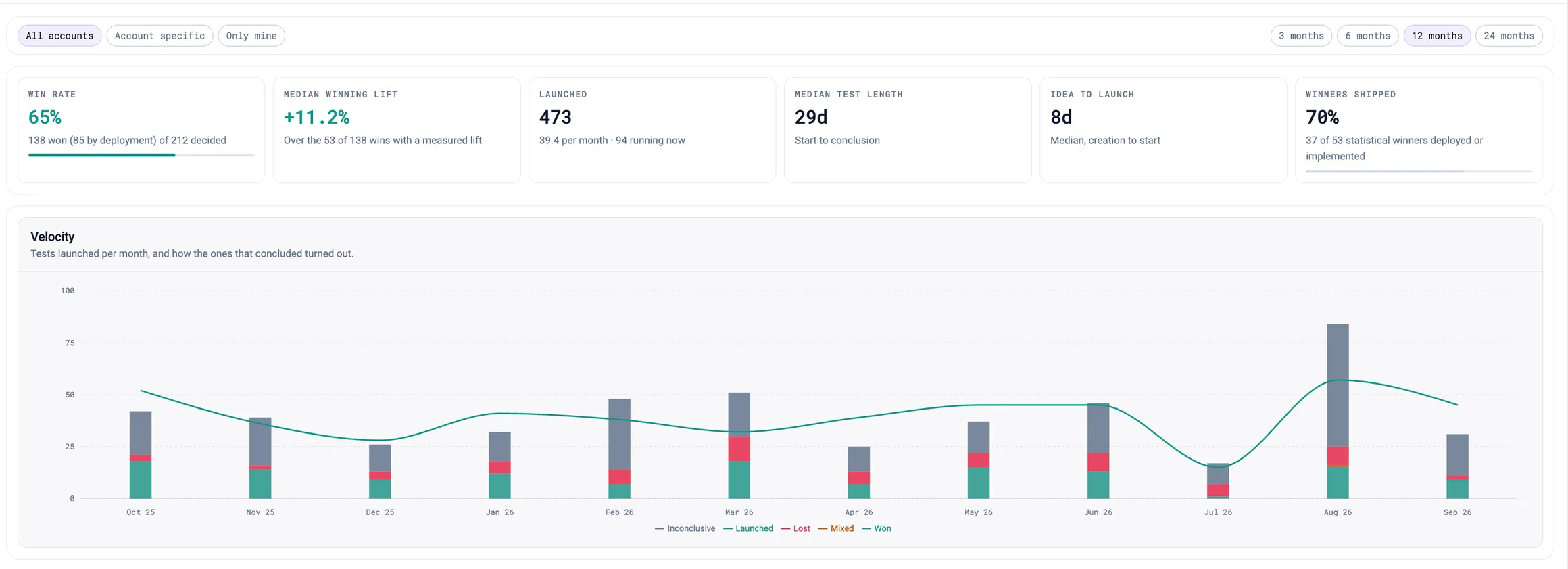
A/B testing is very good at telling you what happened. Variant B won, revenue per visitor moved 4%, ship it. What it has never told you is why, and it has never decided what to test next.
Today we’re shipping both halves of that gap into beta: Surveys, so your visitors can tell you why in their own words, and Pipelines, so your experiment roadmap runs itself.
And we’re shipping them inside something new: a completely redesigned Pertento platform.
This isn’t just a new coat of paint. As Pertento has grown from an experimentation tool into a broader platform for running and understanding experimentation programmes, the interface needed to grow with it. The new UI is faster to navigate, denser where it matters, clearer where it counts, and built to give experiments, surveys, pipelines and everything that comes next a proper home.
Surveys: the “why” behind your win rate
NPS, CSAT and CES: the three instruments that matter, built in with sensible defaults and a four-step builder. Pick a template, tune the questions, choose a trigger, match your brand. Done in two minutes.
But the interesting part is where the survey shows up. You get five triggers: page view, time delay, scroll depth, a dataLayer event, or exit intent. That last one uses two detectors depending on device: cursor-leave on desktop, and a fast upward scroll-velocity signal on mobile. What we deliberately didn’t do is the back-button-trapping trick some tools use on mobile. It’s the most reliable exit signal available, and it breaks the back button on your site. Not a trade we make.
Frequency capping is on by default: 30-day cooldown, max two prompts, and one survey per session, ever, across all your surveys. Two widgets in one visit is how you teach people to dismiss on sight.
A widget engineered like it’s running on someone else’s site, because it is
~5.4 KB compressed. And 0 KB if you have no survey running. The file isn’t lazy-loaded; it’s simply never referenced. Sites without surveys serve byte-identical bundles to before surveys existed.
Zero layout shift by construction, not by measurement: a single fixed-position element in a closed shadow root. Your CSS can’t leak in; our styles can’t leak out.
It never touches page scroll, never swallows your analytics events, respects prefers-reduced-motion, and deliberately doesn’t max out z-index. Winning every stacking contest over your cookie banner and your checkout modal is antisocial.
Responses you can actually use
Every open-text comment is classified for sentiment (positive, neutral, negative) by Claude, on a schedule, with the comments treated as untrusted input: fenced, hardened against prompt injection, refusals handled. Your results screen shows the instrument’s true score (real NPS math, not a generic “score” that means nothing), response rate, sentiment breakdown, and a filterable feed.
And because this is Pertento: survey results split by experiment variant. “How satisfied are you?” is a different question when you can answer it separately for control and challenger.
Pipelines: your testing roadmap, on rails
A pipeline is a board of stages. Each stage is a set of experiments that run at the same time; stages run in order. That’s it. Deliberately not a DAG, because your CRO programme doesn’t need one.
Here’s the part that matters: stages are the exclusion mechanism. On Pertento, concurrent experiments don’t split traffic; every eligible visitor enters every eligible experiment independently. So the only real reason to serialise tests is collisions: two variants mutating the same element, or a redirect test pulling traffic out of another test’s audience. Pipelines put colliding experiments in different stages, each at full traffic, instead of making them mutually exclusive and cutting your sample size N ways.
The collision detector runs server-side while you build the board, flagging selector overlaps, redirect interference and shared goals. The same function runs again before any stage is armed. It’s a detector of likely collisions, worded exactly that way in the UI. We don’t stamp “safe” on anything.
Automation you can watch before you trust
Two switches, both off by default:
Automation. The engine advances stages: when every experiment concludes, when the first result is conclusive, or only when a person says so. Until you flip it, the engine still evaluates your board every minute and logs what it would have done. That dry run is the same function with the same inputs as the real thing: an honest preview, not a simulation.
Auto-deploy. Winners go live without you. And “winner” is a high bar: exactly one variant significant, its entire lift interval above zero, no variant confidently negative. Two winners is a choice for a person, not a calculation.
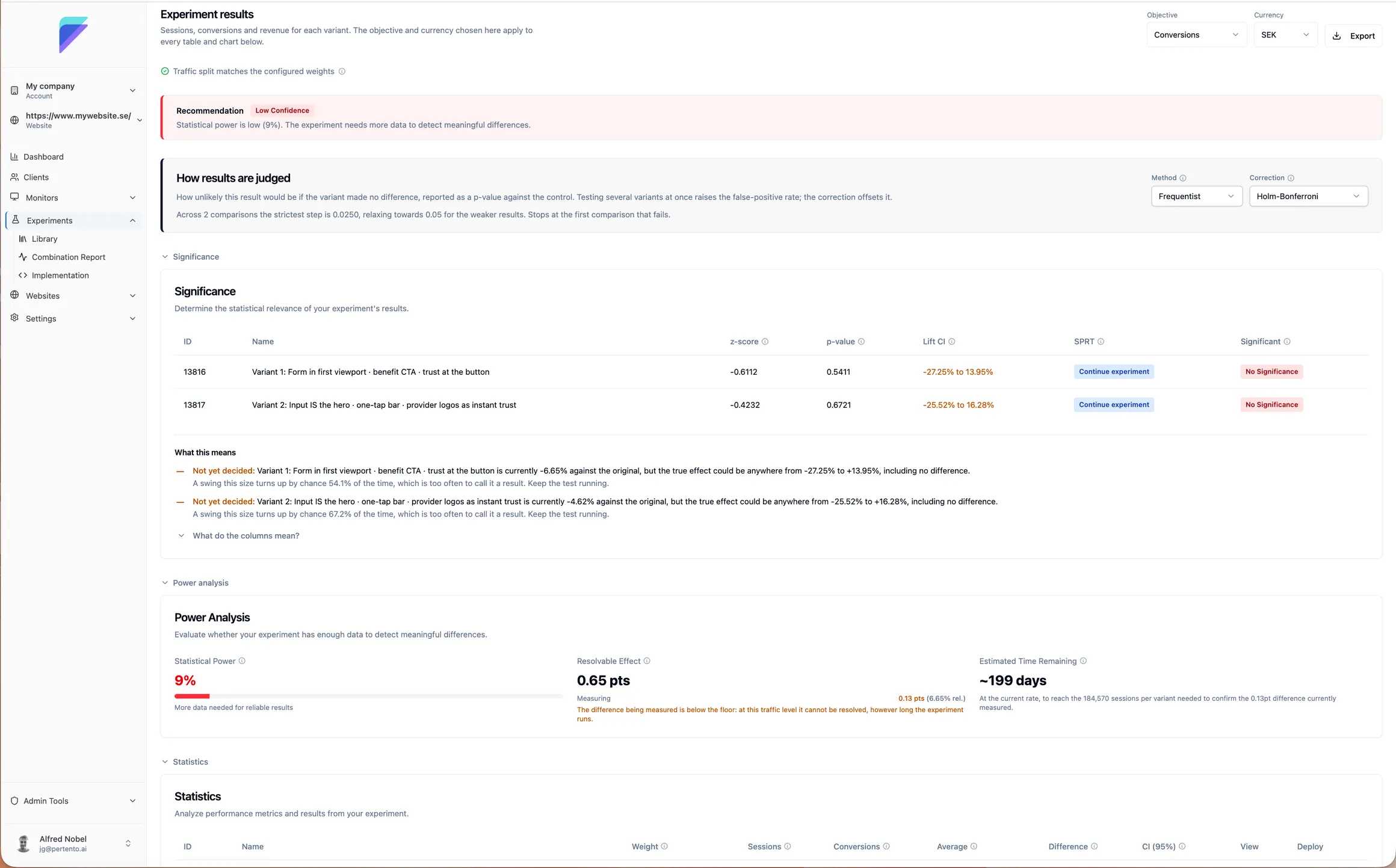
Under the hood, the stopping logic refuses to do textbook optional stopping. An automated check that peeks every minute is the worst case of it. An experiment only stops early when a sequential test (SPRT) and the corrected p-value agree, on the same variant, in the same direction, past a minimum-runtime floor. Every pipeline-started experiment gets a hard time backstop, so no stage can stall your roadmap forever.
A new platform built for what’s next
Three products in one dashboard earned a rethink.
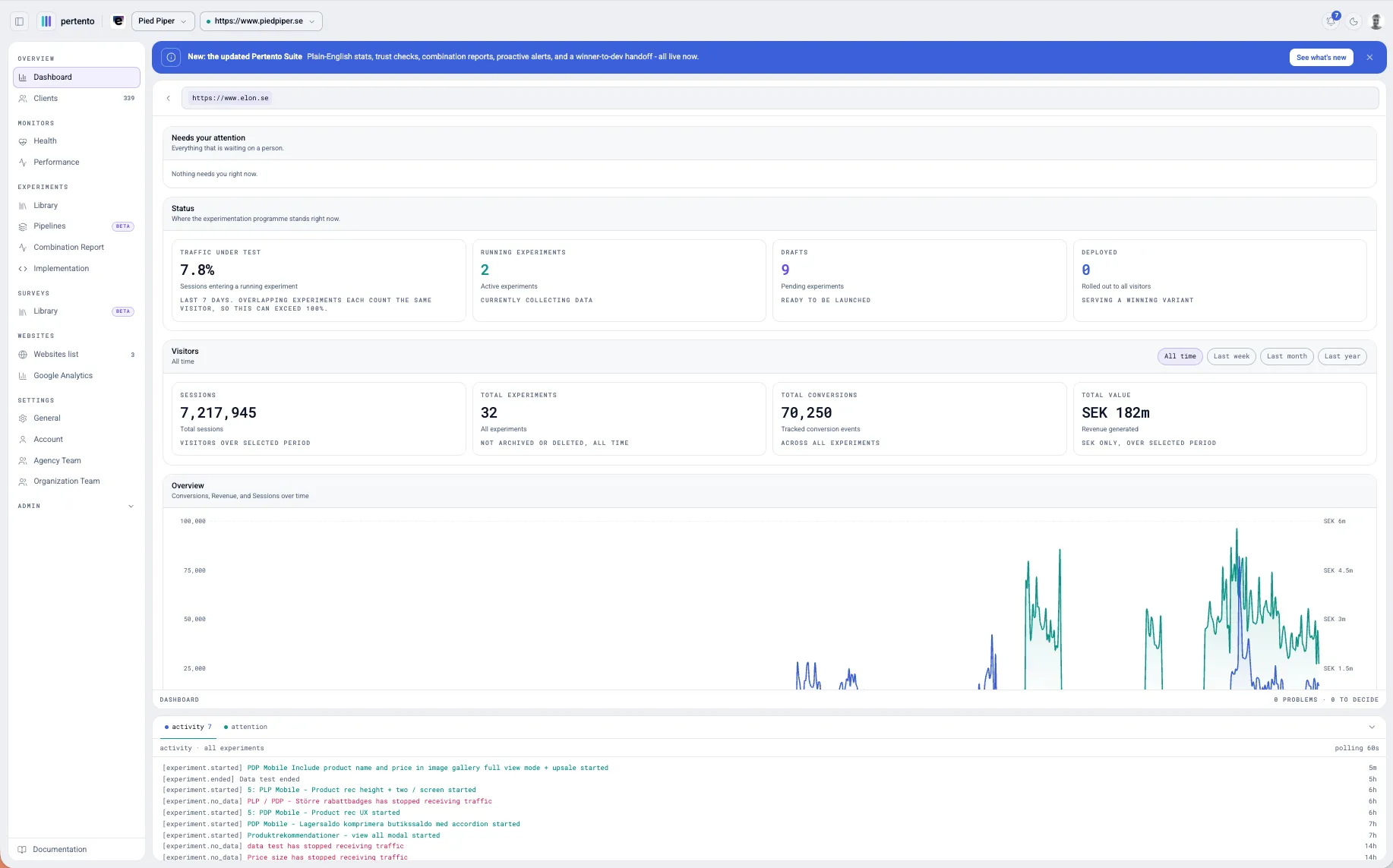
The new Pertento console trades the scrolling document for a fixed desk: panels with their own scroll, a persistent activity log, and controls that stop covering the numbers they govern. Monospace type on every ID, count, timestamp and metric. Dark mode rebuilt on a single token layer instead of two hand-maintained palettes.
But this isn’t simply a redesign around Surveys and Pipelines. It’s the new foundation for Pertento as a platform.
Experiments, results, surveys and pipelines now live within the same interface and interaction model, making it easier to move from identifying an opportunity, to testing it, to understanding the result, to deciding what happens next.
The part we’re proudest of is invisible: the status colour system was measured, not eyeballed. Every state colour is validated for contrast and for colour-vision deficiency, in both themes. In the old palette, “ended” and “broken” were effectively the same colour for roughly one man in twelve. Not anymore.
And the whole thing finally works on a phone: tables become cards, sorting became keyboard-accessible, and touch targets got a real floor.
What beta means
It means we ship it to you before we’ve polished every edge, and we tell you which edges: surveys don’t have scheduling yet, and a few pipeline failure states still want a human eye.
What’s not beta-grade is the part that touches your site and your data. The widget’s isolation guarantees, the durable response path, and the statistics engine underneath it all are the same production machinery Pertento has always run on.
The new Pertento platform is live today, with Surveys and Pipelines available to all accounts in Beta.
Build a survey, draft a pipeline board, watch the dry run, and tell us what you’d change.